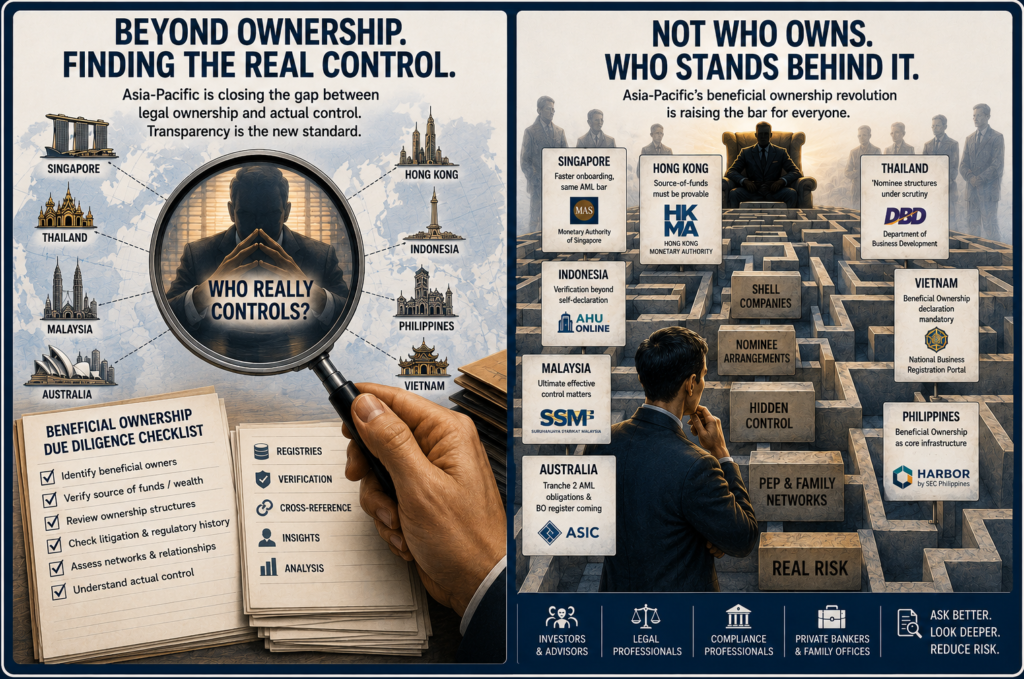
The push for greater ownership transparency is not confined to Asia-Pacific. Even jurisdictions historically associated with offshore wealth structures and corporate secrecy are strengthening beneficial ownership disclosure and access regimes.
The British Virgin Islands, one of the world’s leading offshore incorporation centres, has introduced a centralised beneficial ownership framework requiring companies and limited partnerships to file beneficial ownership information with the Registrar, while also creating a mechanism for persons with a legitimate interest to seek access to that information in specified circumstances.
Although the register remains non-public, the direction of travel is clear: regulators globally are placing increasing emphasis on identifying the individuals who ultimately own, control or benefit from corporate structures.
Against this backdrop, the developments taking place across Asia-Pacific are part of a much broader global shift. What distinguishes many APAC jurisdictions, however, is the pace of implementation and enforcement. Authorities are moving beyond simply collecting beneficial ownership information towards actively verifying it, cross-referencing it across government databases and deploying it as an investigative and enforcement tool.
For investors, financial institutions, legal advisers and compliance professionals, beneficial ownership is increasingly no longer a matter of regulatory compliance alone, it is becoming a critical lens through which to assess risk, control and decision-making before those questions are asked by regulators, counterparties or the courts.
Corporate registry searches used to be just a check-box to tick before closing an investment deal or filing a lawsuit. Not anymore. New beneficial ownership registries, cross-agency verification systems, and/or stricter onboarding standards are going live across Asia-Pacific, with potential implications for investors, lawyers and advisors. Authorities are no longer just recording who owns an asset; they now want to verify who controls it. Relying solely on an official record can now become an unmanaged risk.
The Ownership Illusion
In most investment deals, onboarding or dispute resolution & litigation cases across Asia-Pacific (“APAC”), the ownership structure is usually one of the first things examined, but rarely one of the first things truly understood. Shareholder registers and cap tables tell you who is listed on paper. But they seldom tell you who actually calls the shots, introduced the deal, provided the financing, or ultimately benefits when the case closes. This gap, between legal ownership and actual control, has quietly become one of the most consequential sources of risk in the region’s deals, disputes and wealth management relationships.
It is a gap that authorities across APAC are now moving decisively to close. They are closing this gap with tools and requirements that did not exist a few years ago.
This article provides a practical overview of the following:
- Changes taking place across eight APAC jurisdictions;
- What are the implications and what they mean for your area of work;
- How to effectively use publicly available ownership and corporate records (some of which have been enhanced in recent years); and
- Recognizing their limitations and knowing when and how to go beyond the registries to obtain contextual ground insights.
For a broader set of online due diligence and investigative resources across APAC — categorized by country and with direct URLs — you may also find our earlier article useful: Fortifying Your Strategy: Free Toolkit for Due Diligence Investigation.
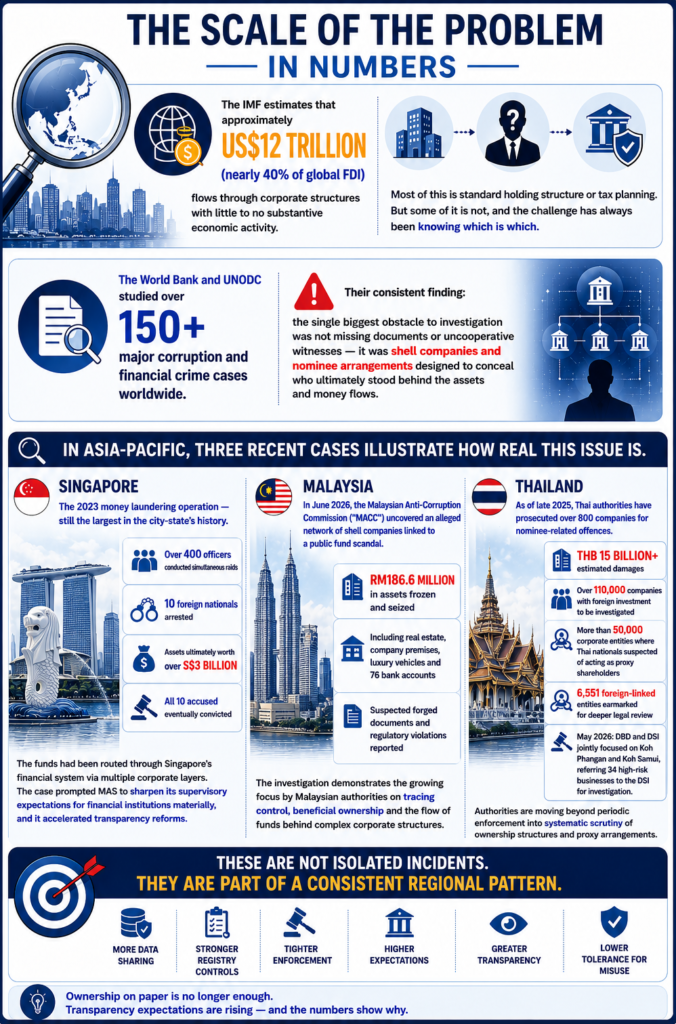
The Scale of the Problem In Numbers
Before getting into what is changing across APAC, a quick sense of scale helps frame why this matters.
What Is Changing Across Asia-Pacific
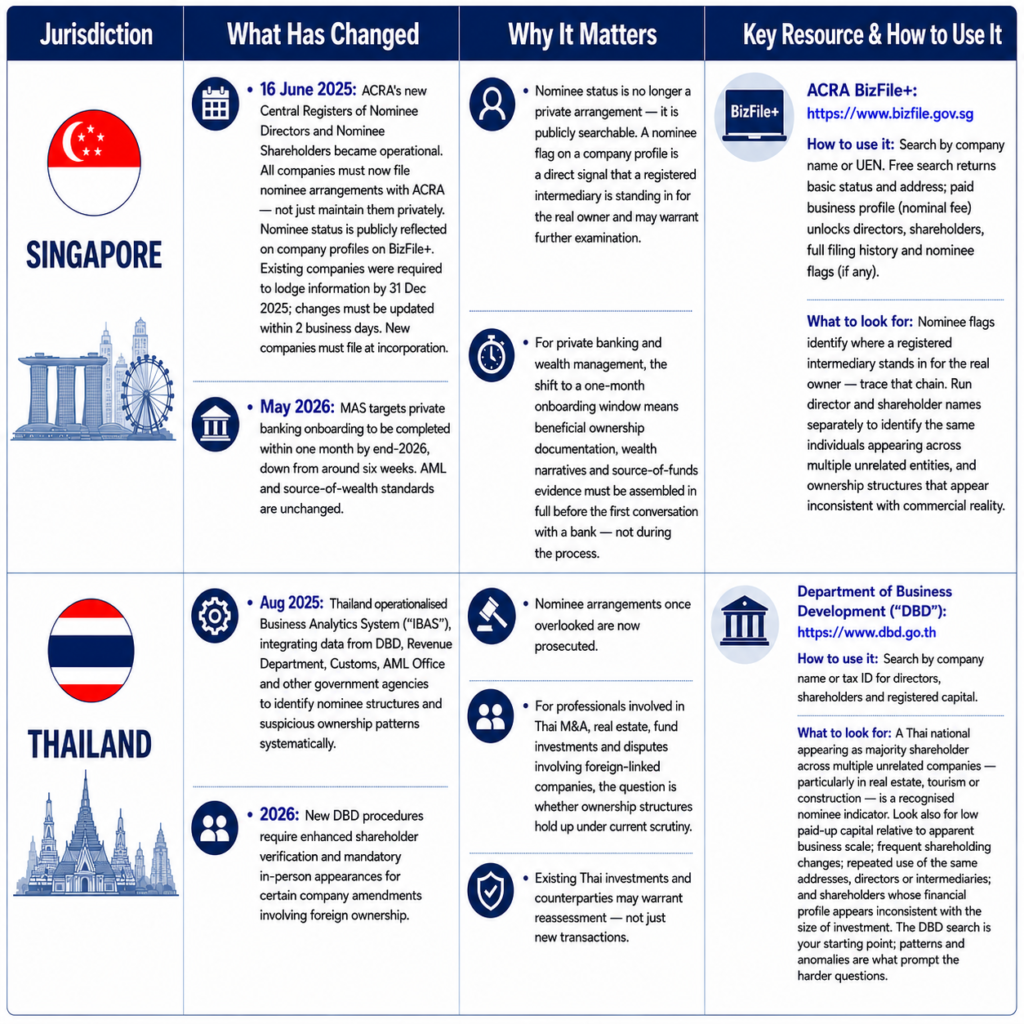
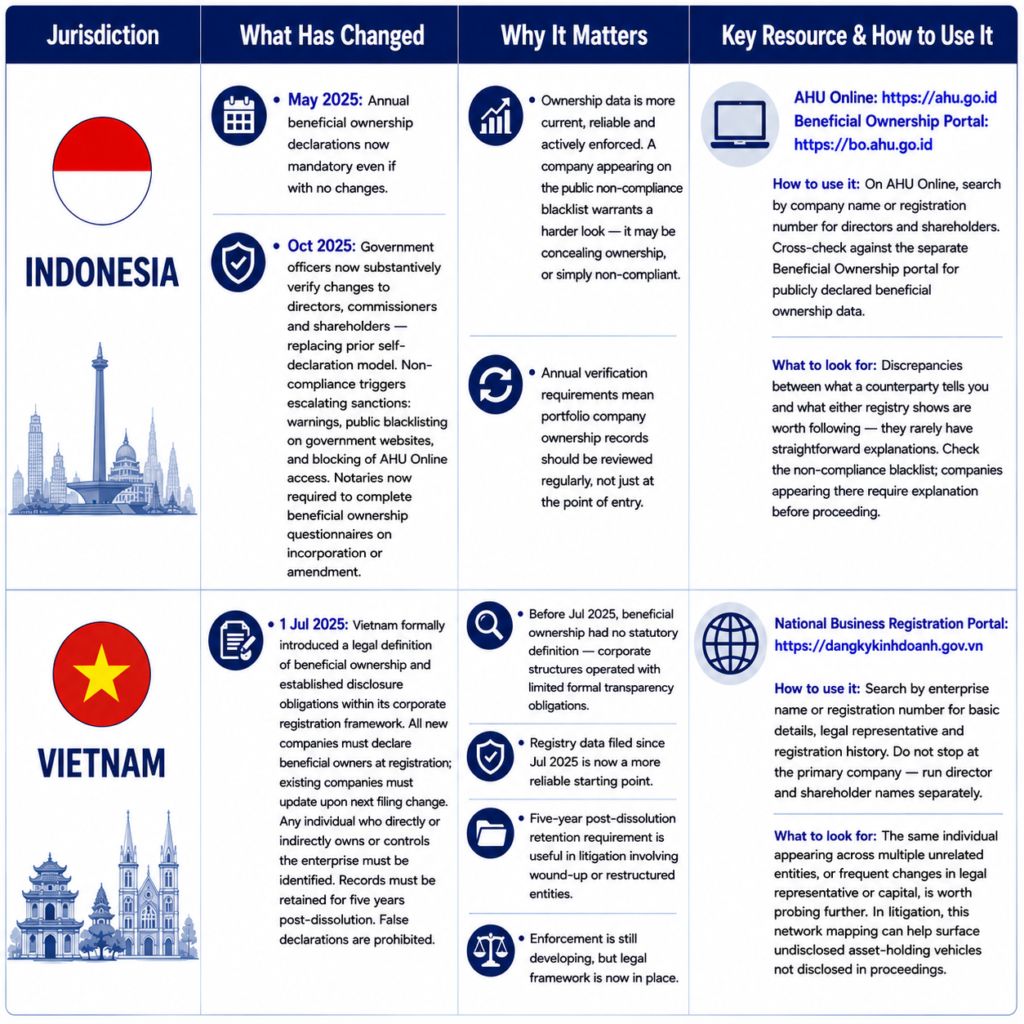
This is not simply an incremental narrative about regulatory compliance. It is a fundamental paradigm shift. The underlying trajectory is uniform across at least eight APAC jurisdictions. Basically, authorities are no longer satisfied with self-declared ownership at face value. They now want verified, demonstrable proof of operational control. And the digital systems required to audit these structures are being built or operationalized. The tables below outline the key regional developments; what has changed; why each matters; and how to use the existing or upgraded resources practically.
Asia-Pacific Ownership Transparency and Control: A Practical Reference (2024-2026)
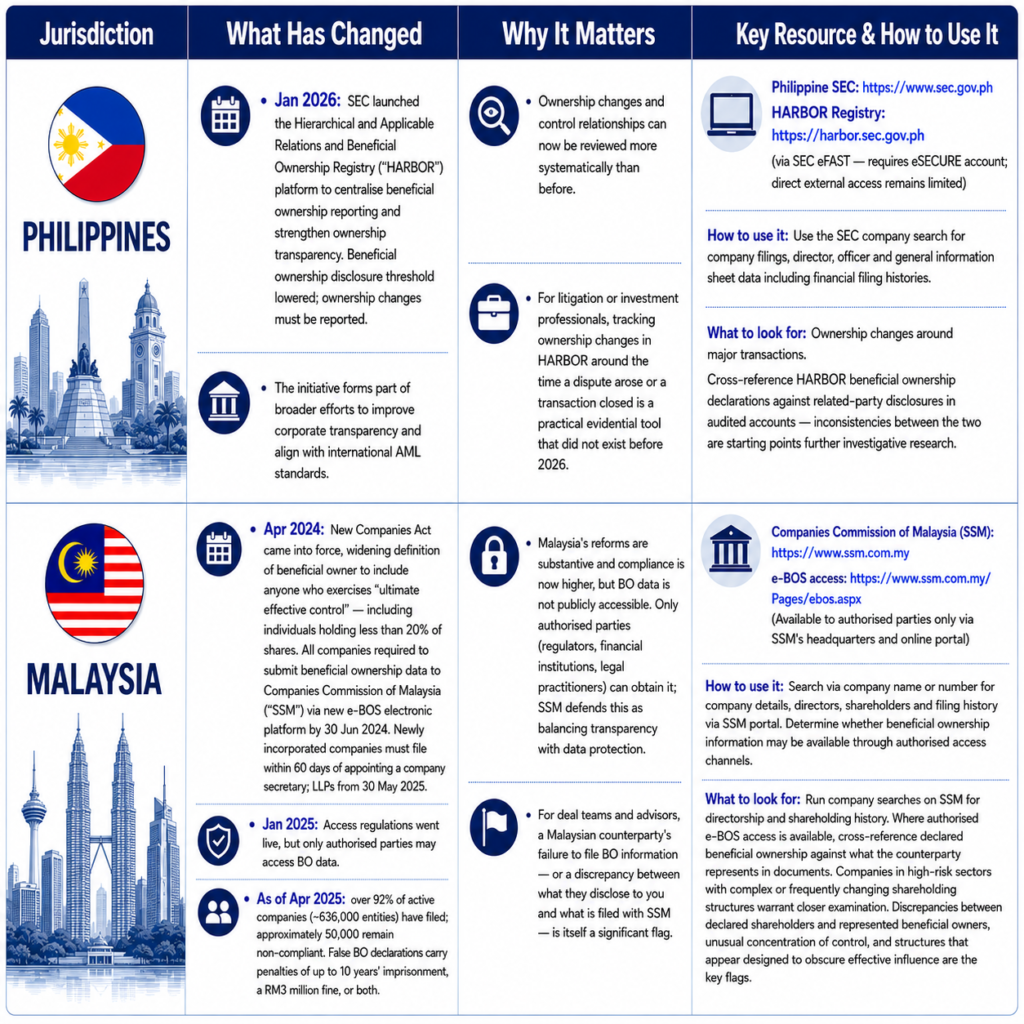
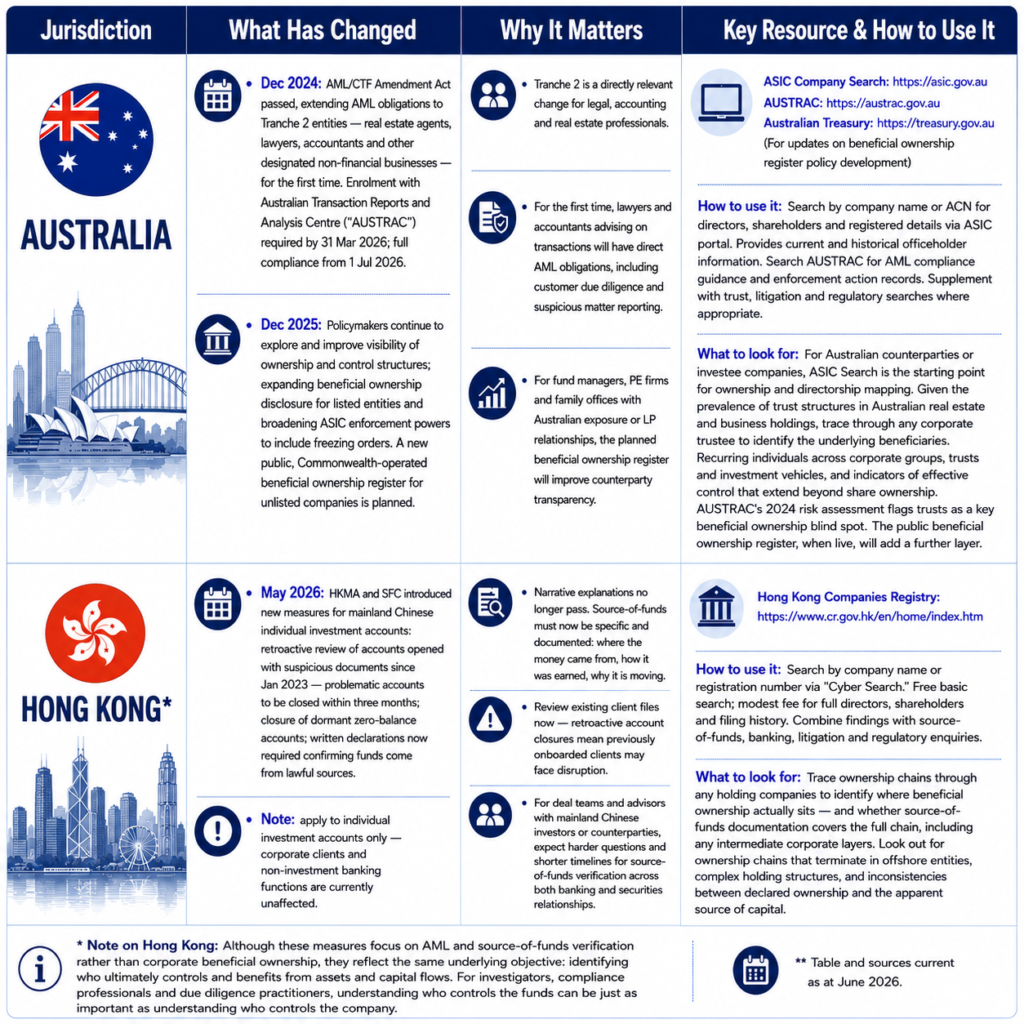
What the Registries Will Not Tell You
While the region’s upgraded compliance and regulatory frameworks represent a meaningful step forward, we must remain clear-eyed about their structural limitations.
A database search, however comprehensive, only reveals who holds ownership or control as recorded on paper. It rarely exposes who wields actual power on the ground.
The true ultimate beneficial owner, the PEP intermediary, the proxy family member exercising informal influence, and the silent financier providing the underlying capital — none will appear in standard databases if the explicit intent is concealment. This visibility gap creates immediate, material consequences across two distinct corporate contexts:
Pre-Transaction Due Diligence: The Shadow Control Risk
- In localized or cross-border transactions, the primary risk is closing a deal based solely on legalized paper structures while remaining unclear about actual operational dynamics.
- A counterparty whose disclosed shareholders look entirely clean may still be operationally directed by a shadow actor whose political exposure, legacy litigation history, or sanctions connections would have been material to your investment decision.
- Ownership records only verify who is officially registered. They cannot tell you who is driving the deal, who is making the executive decisions behind closed doors, or who ultimately extracts the economic benefit when the transaction closes.
Dispute Resolution & Litigation: Piercing Nominal Ownership
- In corporate disputes, the chasm between registered ownership and actual control can frequently become the exact pivot point upon which a case turns.
- Whether navigating asset tracing, fraud recovery, shareholder actions, or judgment enforcement, courts and arbitral tribunals are becoming sophisticated about this distinction.
- Proving substantive, de facto control (rather than relying on nominal, front-facing ownership) is the core legal challenge. Official registries are merely where the investigative work starts, not where it finishes. Bridging this gap requires localized ground insights to uncover the relationships that databases miss.
The Questions That Can Take the Analysis Further
Whether you are assessing a potential investment, investigating fraud, or building a litigation strategy, a registry search is often the starting step, and not the conclusion. The questions below, while not exhaustive, can help guide the next stage of analysis and uncover issues that may not be immediately apparent from searching records alone. It is also worth noting that some of the most valuable answers may not be found in any public filings. But rather, through contextual research, industry knowledge, and ground insights to test if the ownership structure reflects commercial reality.
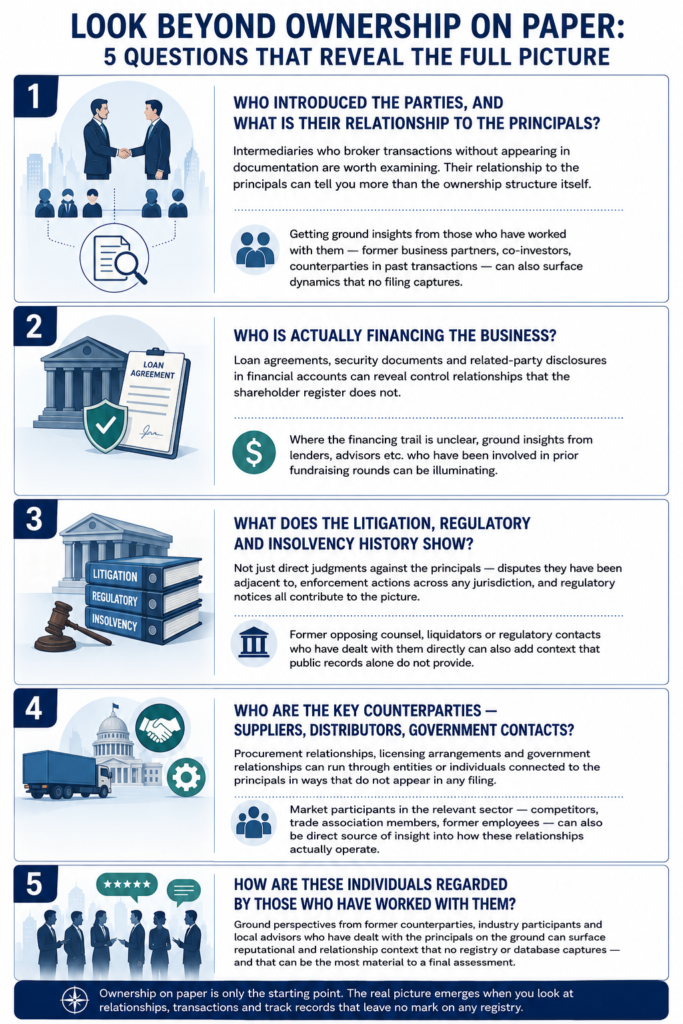
These questions do not replace public record searches. They build on them, and the answers — drawn from both documented sources and informed insights from those who know the principals directly — can often reveal more than the ownership record alone.
What This Means for Your Work
Transaction and Investment Professionals
- Beyond the checklist: Beneficial ownership diligence is no longer a last-minute check-box to tick before closing.
- The cost of blind spots: Across APAC, incomplete ownership analysis now creates notable exposure: regulatory risk for licensed institutions, financial risk for investors, and potentially irreversible reputational damage if the true ownership structure materially contradicts what was represented.
- The modern diligence toolkit: Effective due diligence today needs to bridge public records with local reality. It combines database searches with informed ground insights from market participants who know the entities and their operating environment. These perspectives do not appear in any filings, yet they can often be decisive.
- Proactive integration: The frameworks outlined here are practical starting points worth building into your standard process now, not when a problem has already surfaced.
Litigation and Dispute Resolution Professionals
- New evidentiary anchors: Modern corporate registries and verification systems now available across the region are increasingly useful as evidence anchors — for establishing control, tracing assets and demonstrating that ownership representations were inaccurate or incomplete.
- Leveraging discrepancies: A clear mismatch between a formal registry entry and a contractual representation gives a court or tribunal concrete, actionable evidence to work with.
- Expanded lines of enquiry: These public resources also unlock investigative paths that were impossible to pursue publicly just a few years ago.
- Building a bulletproof narrative: To strengthen a case, pair the documentary record with first-hand accounts from those with direct knowledge of the parties, e.g. former associates, creditors, and past counterparties. This can provide the critical narrative context and corroborating detail that documents alone cannot capture.
Family Offices and Private Banking Professionals
- The end of the loose narrative: The days of clearing onboarding using loosely assembled ownership narratives and enduring endless rounds of bank queries are over, particularly in Singapore and Hong Kong.
- The new standard: Institutions now demand a coherent, complete, and fully documentable beneficial ownership profile, ready to answer precise questions about wealth generation and structural control before the first conversation with a financial institution.
- Bridging the documentary gaps: Where documented records are sparse, look to informed perspectives from those who know the client’s background and business history. This insight fills critical gaps, streamlining the onboarding process rather than complicating it.
Why Does Any of This Matter to You
Beneficial ownership and source-of-wealth transparency have traditionally been treated as routine compliance formalities rather than core business risks. Historically, a standard registry search was run, the shareholder register was reviewed, and the analysis stopped there. Today, that approach is increasingly inadequate. The cost of relying on it is escalating. Structures that once escaped scrutiny are now more likely to be challenged, tested, and prosecuted.
This shift matters because it has evolved past a simple regulatory narrative. It is now a critical risk management and strategic decision-making story that can directly impact one’s bottom line.
The Real Cost of Corporate Blind Spots
Operating with an incomplete ownership picture can expose your business to severe, unhedged vulnerabilities:
- Uncaptured transaction risk: Deals closed on incomplete data carry hidden financial and reputational liabilities that standard due diligence misses.
- Unmitigable liabilities: A counterparty concealing a politically exposed principal or a sanctioned network is a systemic threat that no legal agreement can adequately address.
- Avoidable operational friction: Onboarding files that cannot withstand rigorous source-of-wealth scrutiny face immediate, disruptive rejections by financial institutions.
- Disadvantaged legal strategies: Commercial disputes where the ultimate beneficial owner remains hidden are significantly harder and more expensive to resolve.
These are not hypothetical scenarios. These are real-world flashpoints where the cost of not knowing becomes material.
Moving Beyond Compliance to Strategic Certainty
Mastering beneficial ownership analysis is no longer about satisfying a regulatory checklist. It is a strategic tool used to:
- Discover exactly who you are dealing with on the other side of the table.
- Identify hidden influence, proxy structures, and undisclosed conflicts of interest.
- Quantify reputational and enforcement risks before they crystallize into crises.
- Trace hidden assets efficiently when commercial disputes arise.
- Make defensible, high-conviction decisions at every stage of the business lifecycle.
The New Standard for Business Insights
Fortunately, the capabilities required to uncover these insights have advanced materially. The investigative frameworks available today are practical, accessible, and more useful than most practitioners realize when used thoughtfully. Leveraging these resources is no longer a competitive differentiator. In the current climate, failing to use them can become a liability.
In an era where APAC beneficial ownership frameworks are evolving rapidly and enforcement is accelerating, a strategy that pairs documentary rigor with informed ground insight, in our view, is the most reliable foundation for sound business decisions.
⚠️ Disclaimer: The information and resources herein are provided on a best-effort basis and for general reference, informational and educational purposes only and do not constitute legal, professional, investigative, or advisory services of any kind. They are intended as a simplified practical reference to assist users. Information derived from third-party sources may be incomplete, inaccurate or subject to change. No representations or warranties, express or implied, are made as to the accuracy, completeness, or suitability of this material. All liability arising from reliance on these materials is expressly disclaimed. Users are solely responsible for exercising independent judgment in their application.