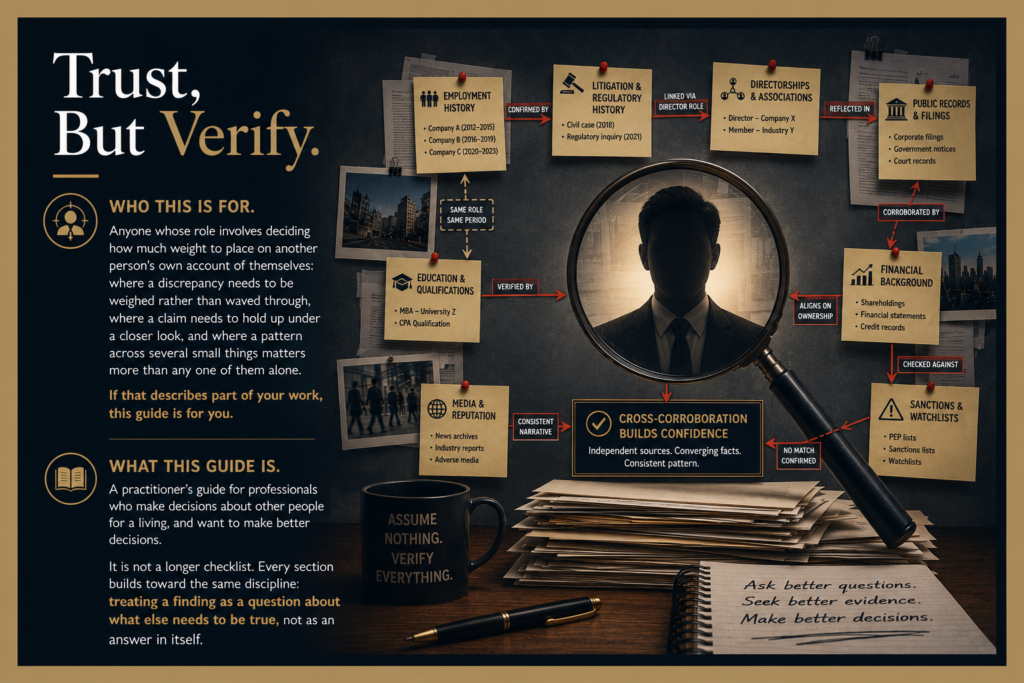
Every important decision about a person typically begins with one question:

How much of what you think you know has actually earned your confidence, and what remains unknown?

Confidence is earned through independent verification, not persuasive narratives.
In background screening, sometimes the risk lies in information that is deliberately false. Just as often, it lies in what was never disclosed. Both distort the picture the same way, which is why a background check can come back “clean” and still miss the very issue that would have changed the crucial decision.
Effective screening means reconstructing an individual’s history independently, testing the narrative presented, and recognising that what is absent can also be as significant as what is disclosed.
Why Assessing Can Be More Difficult Than It Appears
The challenge in screening and assessing people is rarely one of information alone. It is also one of judgement: determining how much confidence the available information genuinely deserves. Sometimes the difficulty lies in scarcity; at other times, in an abundance of information that has not been independently corroborated.
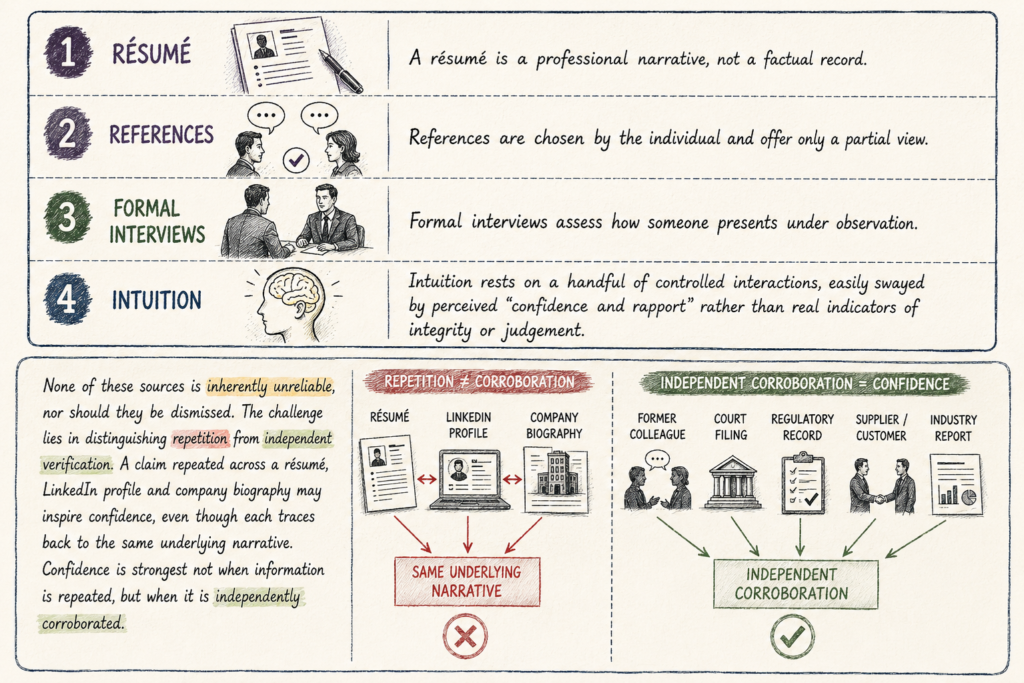
This Practitioner’s Guide is built around a simple but important principle: effective background screening is not about accumulating more information, but about determining which information has genuinely earned your confidence. Rather than accepting an individual’s narrative at face value, the guide adopts a structured methodology to independently reconstruct the underlying picture, test the information presented, and identify not only what is known, but equally what may be missing. The objective is to develop confidence through independent verification, critical analysis and informed judgement. It does so through two complementary approaches:
- Public Source Research – Systematically verifying information through corporate registries, regulatory filings, court records, official disclosures, media reporting and other publicly available sources to establish an objective factual foundation.
- Independent Enquiries – Obtaining informed perspectives from people with relevant knowledge to provide context, clarify inconsistencies, independently corroborate key findings and bridge the gaps that documentary records alone cannot fill.
Throughout the guide, practitioner insights and practical techniques are also shared to demonstrate how these findings should be interpreted and contextualised within APAC’s diverse legal, commercial and cultural environments, where the significance of the same information can vary markedly across jurisdictions and circumstances.
Public Source Research: Common Areas of Review and Practitioner Insights
Effective background screening is rarely defined by how many databases were searched. It is defined by the quality of the questions asked, the discipline of independent verification, and the nuanced interpretation applied to what the records reveal, as well as what they do not.
Our earlier articles Fortifying Your Strategy: A Free Toolkit for Due Diligence Investigation and Beyond the Investigative Toolkit: Practical Strategies to Uncover Hidden Gems, compiled extensive lists of official databases, registries and publicly available resources across Asia-Pacific (“APAC”). Rather than reproduce those lists here (please refer to the earlier articles for details), this section builds on that foundation. The focus here is not where to search, but how to use those resources effectively, the techniques to apply, and the practical pitfalls and regional nuances that can turn a seemingly thorough search into a misleading one.
Practitioners seldom treat a result in isolation. They move constantly between verification, assessment and understanding to judge whether the data tells a coherent, complete story. And, never forget that APAC is a patchwork of legal systems, languages, cultures and disclosure regimes, not a single market. What works in one jurisdiction may be ineffective in another.
A. Identity Verification: Confirm You Have the Right Person
This may sound painfully obvious, yet it remains one of the most common causes of both false positives and false negatives. Once an incorrect record is attributed to an individual, everything subsequently built on it risks being compromised. One of the quickest ways to undermine an otherwise well-executed check is to investigate the wrong person.
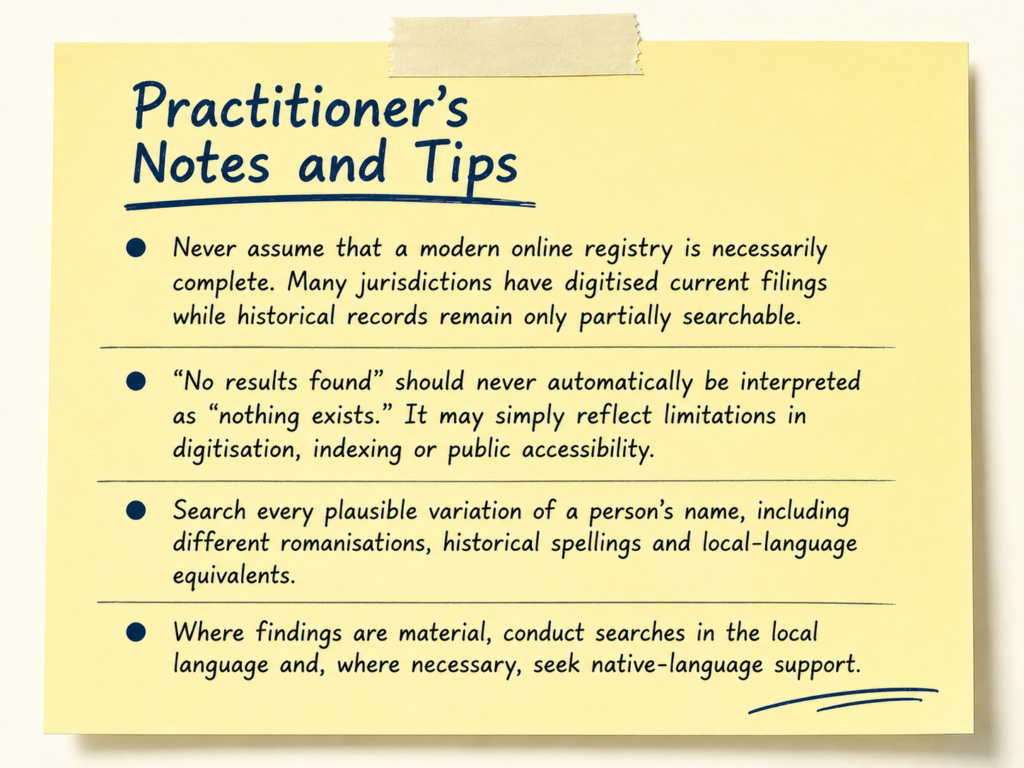
Identity matching can sometimes be challenging across APAC. Common surnames, multiple languages, inconsistent romanisation (e.g. a Chinese name can be romanised several defensible ways: Pinyin, Wade-Giles, Cantonese, or an English name with no phonetic link) and legitimate name changes (after marriage, conversion) mean a relevant record can sit under a different spelling entirely, or someone else’s history can be attributed to your individual.
A name should almost never stand alone. Build confidence through multiple identifiers, such as ID numbers, date of birth, nationality, addresses, family associations, company appointments, before accepting any record as relevant. The goal is ensuring every later conclusion genuinely relates to the individual being assessed.
B. Career, Qualifications and Professional Record: Verify the Facts, Not the Narrative
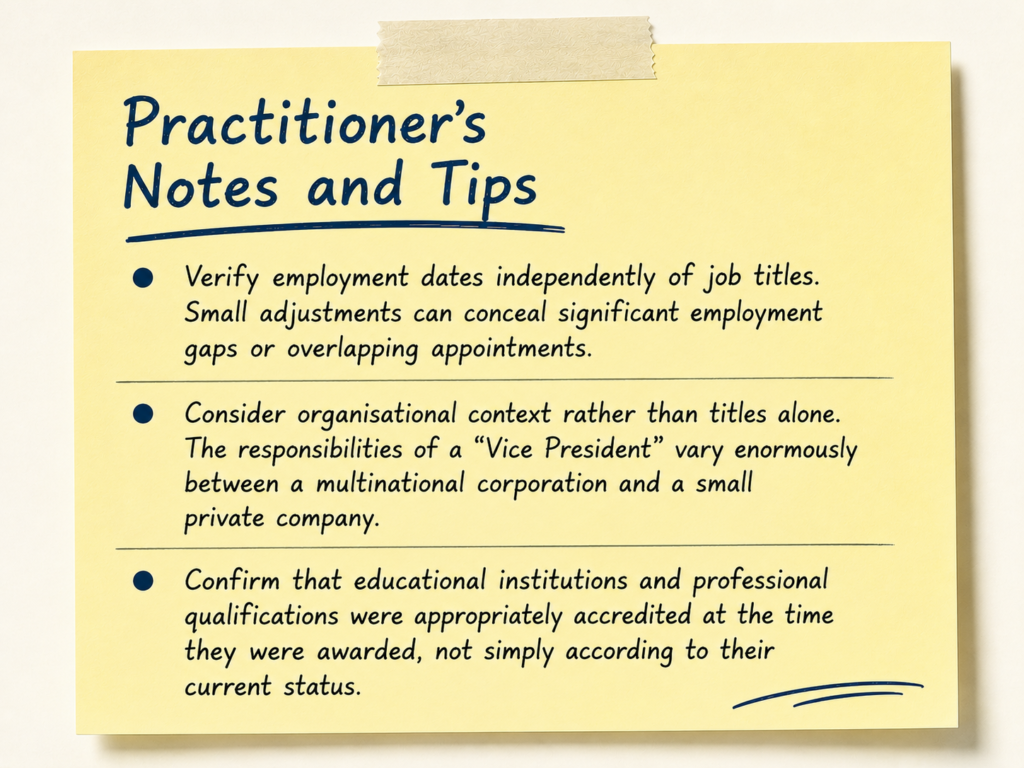
Once identity is confirmed, reconstruct the individual’s professional history from independent sources rather than solely on the narrative presented. Employment history, qualifications, licences and directorships and other appointments should be verified against primary records wherever possible. This is not merely to confirm isolated facts, but to test whether the whole chronology holds together.
People rarely fabricate an entire career. More often they adjust dates, omit failed ventures, leave gaps unexplained, or present titles without context. Viewed individually, these discrepancies may look insignificant. Viewed collectively, they may reveal a pattern worth closer examination. Practitioners compare records against each other, flagging inconsistencies that warrant clarification rather than jumping to conclusions.
C. Corporate Associations and Conflicts of Interest: Relationships Can Tell More of the Story
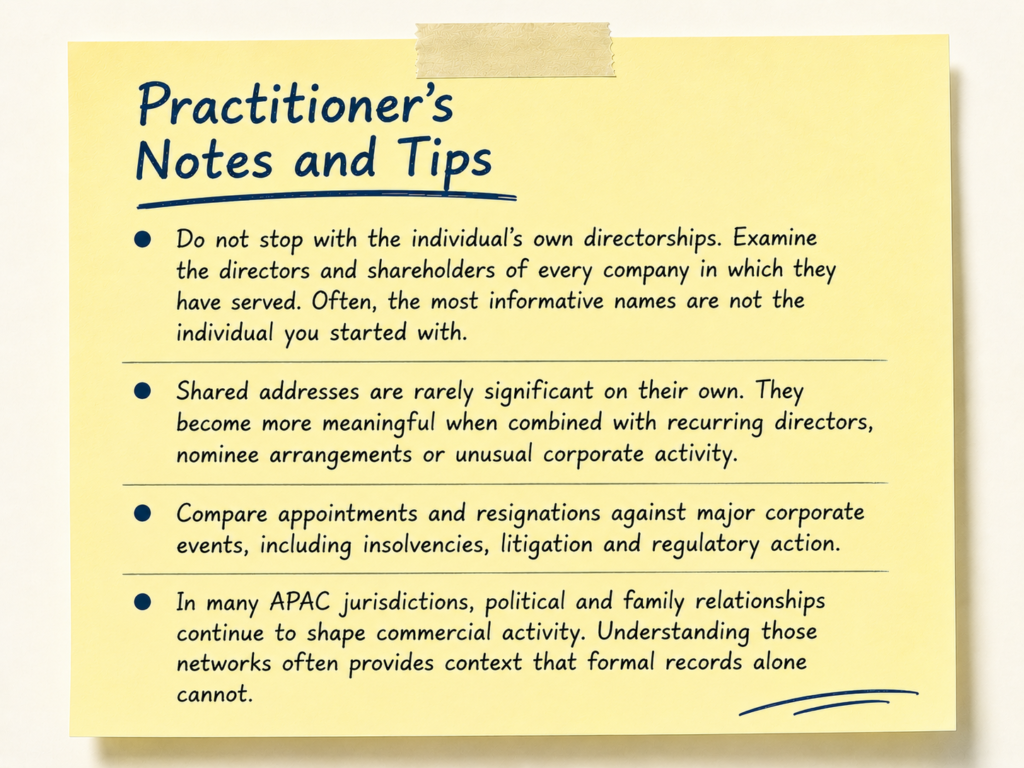
People do not operate in isolation. They can create risk through their own decisions, but those decisions are often shaped, enabled or amplified by the individuals, companies and networks around them. Understanding a person’s professional relationships can therefore be just as important as understanding their own history. Rather than limiting the review to employers listed on a résumé, broaden the enquiry to current and former directorships, fellow directors, shareholders, beneficial owners and recurring corporate connections, asking:
- Have the same individuals repeatedly served together across multiple companies?
- Do seemingly unrelated or competing businesses share directors, shareholders or registered addresses?
- Did resignations occur shortly before insolvencies, litigation or regulatory action?
- Does the individual’s network reinforce or contradict the narrative presented?
One connection hardly proves very much. More revealing are relationships that recur across different companies, transactions or time. The objective is not guilt by association, but to understand whether those connections expose potential conflicts of interest, concentration of influence, undisclosed commercial interests or other factors that materially affect how the individual’s background should be interpreted.
D. Adverse and Enforcement Records: Read Beyond the Headlines
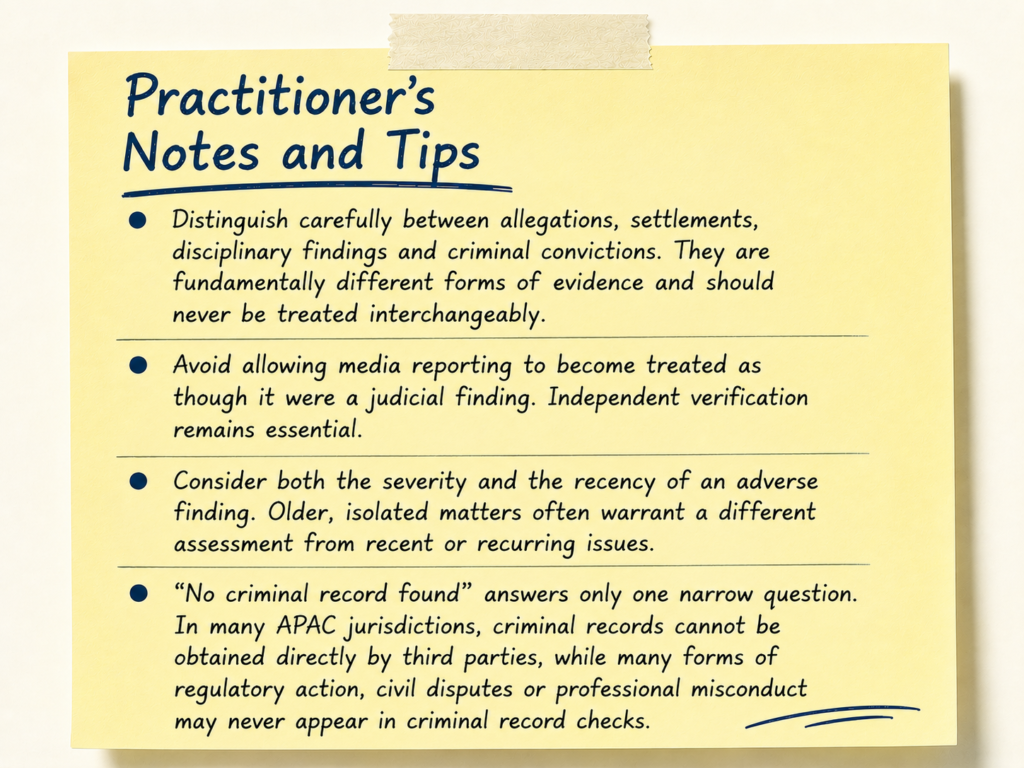
Searching for litigation, insolvency or disciplinary records is fairly straightforward; interpreting what those records mean is where judgement begins. An important distinction is recognising that not all adverse records carry the same significance. A civil lawsuit, regulatory reprimand and criminal conviction are fundamentally different forms of evidence. Even within the same category, the circumstances often matter more than the headline. Practitioners therefore ask:
- Was the individual the claimant, defendant, or merely mentioned?
- Were the allegations proven, settled or dismissed?
- Was the action administrative, disciplinary or criminal?
- Is the matter isolated or recurring, concluded or still ongoing?
The context determines whether a finding is significant, immaterial or simply requires clarification. The significance of a record depends on what happened, why it happened and how it fits within the individual’s broader history. A civil dispute resolved amicably 10 years ago carries very different implications from repeated litigation, persistent regulatory action or an ongoing investigation. Treating every adverse finding as equally significant risks both unfair conclusions and poor decision-making.
A risk that is particularly relevant across APAC, where disclosure practice varies widely: some jurisdictions publish judgments routinely, others resolve disputes confidentially. A “clean” result therefore carries different weight depending on where the individual has lived and worked.
E. Global Compliance and Regulatory Checks: Look Beyond Domestic Records
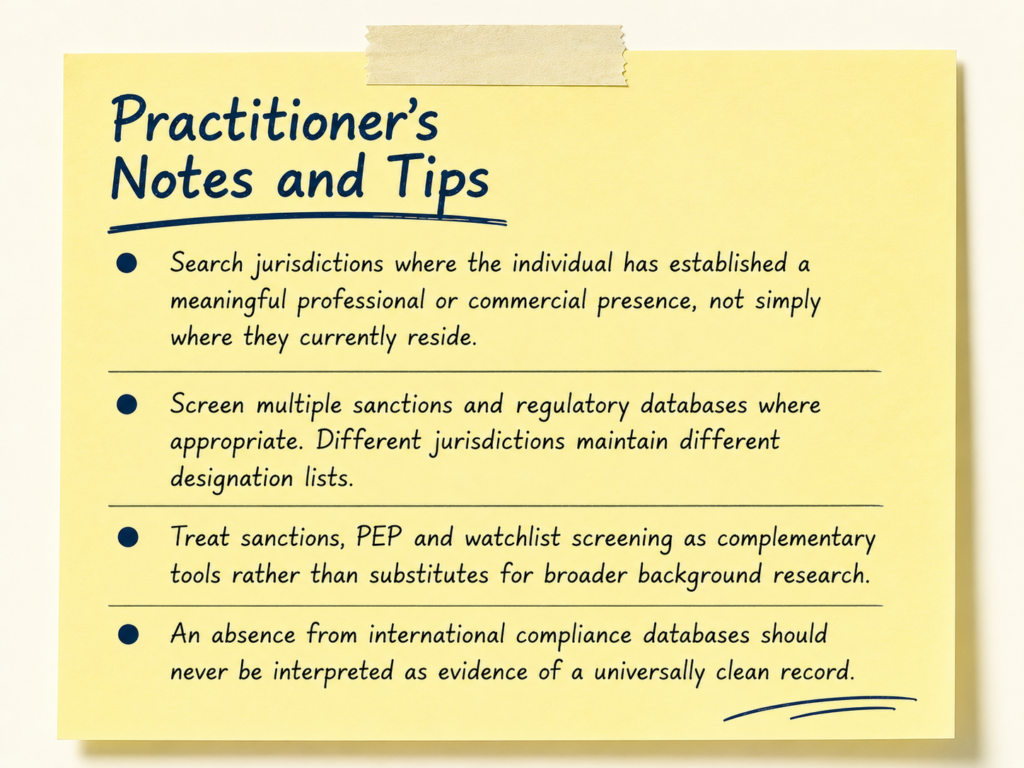
Careers increasingly span multiple jurisdictions, and the screening should follow: every jurisdiction where the individual has lived, worked, studied, held an appointment or built a meaningful presence. It should not only cover the individual’s current jurisdiction. A resignation recorded overseas or an appointment omitted from a résumé can materially change a risk assessment, even where no negative record has been found.
Screening should also extend to international watchlists, sanctions lists, Politically Exposed Person (“PEP”) databases, professional disciplinary and regulatory enforcement records. These go beyond compliance exercises to test whether the individual’s profile stays consistent across borders, and surface gaps worth further enquiry. Notably, each of them answers a narrow question, not the whole one. A sanctions list flags a specific government measure; a PEP database flags political exposure, not misconduct. The absence of one does not imply the absence of all.
F. Profiling and Adverse Media Review: Search for the Story, Not Just the Name
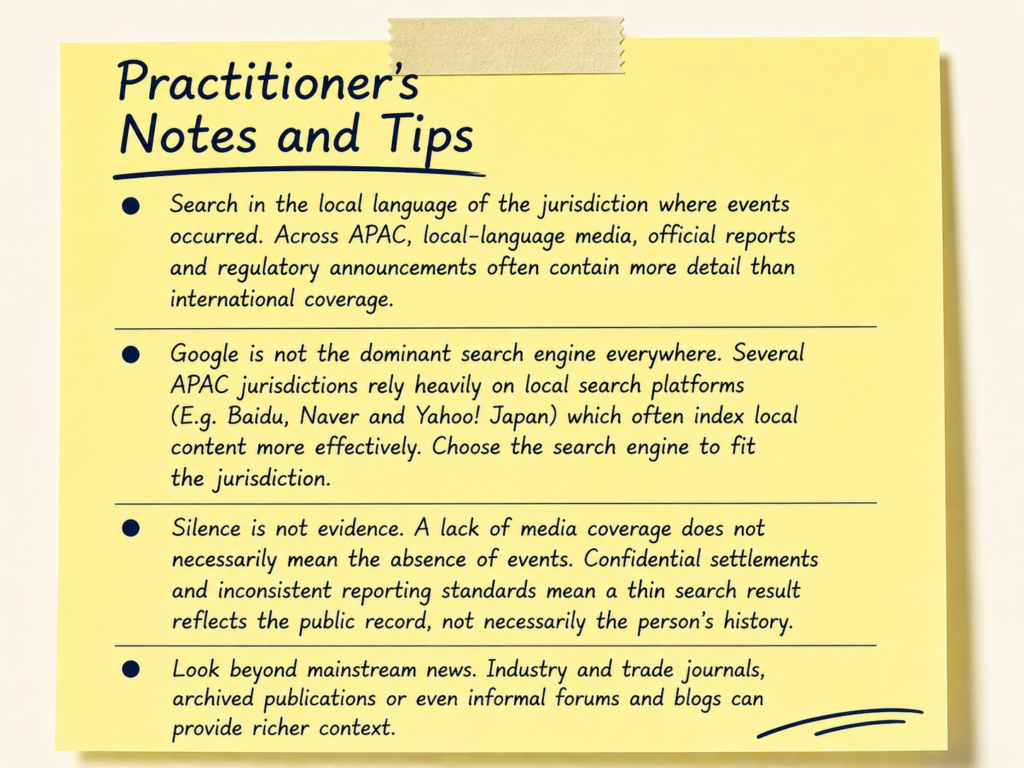
Media searches often amount to little more than typing a name into a search engine. Practitioners ask a different question: not “What has been written about this person?” but “If this career unfolded as described, what public footprint would I expect to find?” That shift transforms the exercise from finding articles to reconstructing the individual’s public footprint. The search is broadened by examining the individual alongside former employers, business partners, companies founded or led, and significant events such as litigation, M&A or regulatory action.
Equally important is weighing the quality of what surfaces. Not every article deserves the same weight: is it corroborated, is the publisher reputable, does it report verified fact, allegation or commentary? Distinguishing between these is critical. A single article is rarely conclusive, but it can point toward something worth pursuing.
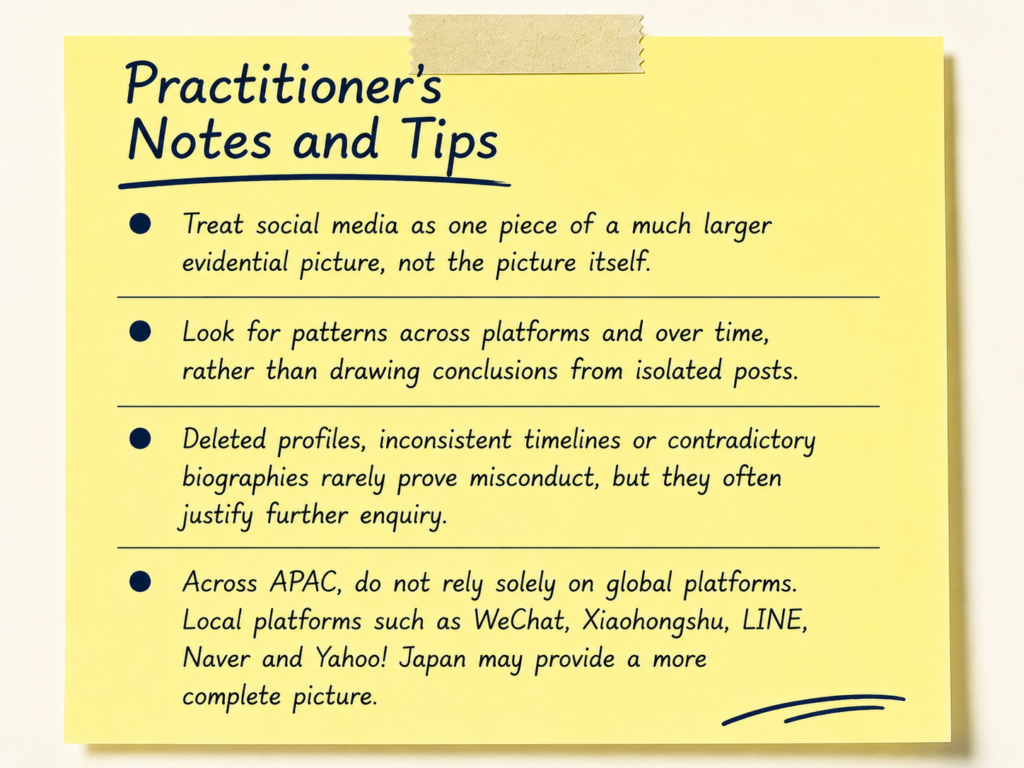
G. Social Media Profiling: Understand the Context, Not Conclusions
Digital footprints across professional and social media platforms can reveal employment chronology, networks and behaviour that formal records miss. The goal is not purely to judge personality, but to test whether the footprint is consistent with the narrative presented elsewhere.
Social media is one of the richest channels of public information today, yet one of the easiest to misread: curated profiles and adverse posts both distort as much as they reveal. An endorsement may be exchanged rather than earned; a negative post may reflect a legitimate concern or a personal grudge. Practitioners seldom treat either at face value, instead they use it to add context and generate leads to verify independently.
Limits of Public Records and Online Research in APAC
The growth of digital records and AI-powered search have transformed background screening. What once took weeks can now be found in minutes. But greater accessibility should not be mistaken for greater completeness. Even the most thorough online search is limited to what is publicly available and discoverable, and it cannot reveal everything that exists.
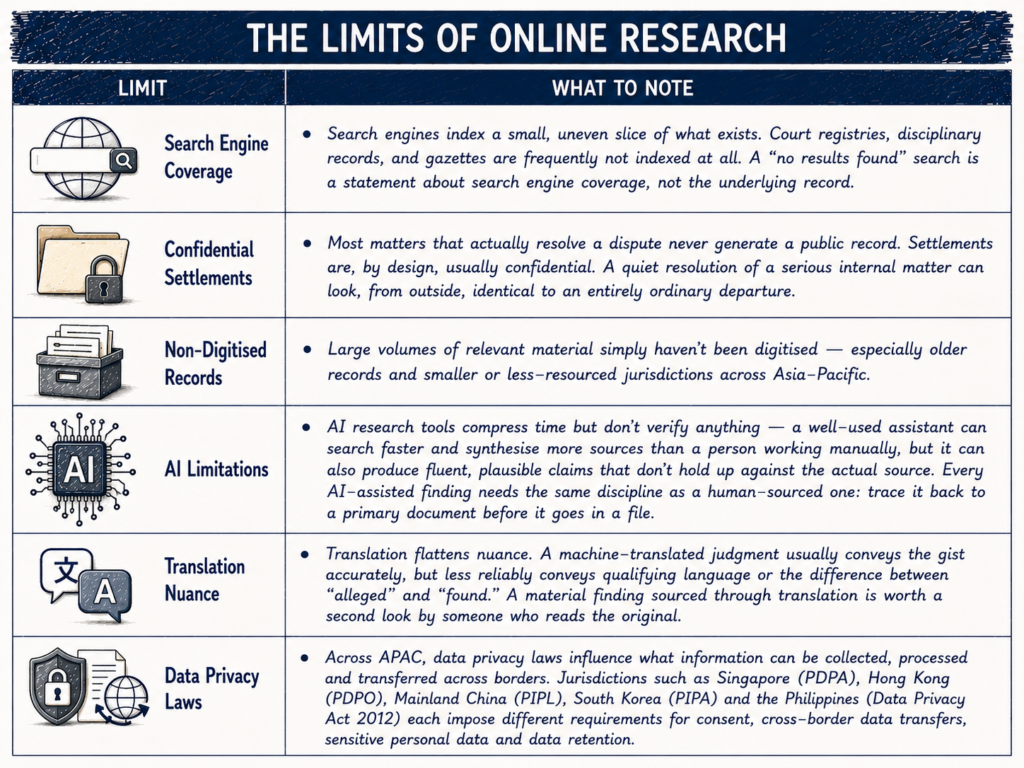
None of this makes screening inherently more difficult; it simply requires a clear understanding of what public sources can, and cannot, establish. The aim is not to tick every box, but to reach conclusions that are proportionate to the available information while being transparent about where uncertainty remains. Presenting incomplete research as a complete picture creates unwarranted confidence and may obscure issues that warrant further enquiry.
Independent Enquiries: Common Areas of Focus and Practitioner Insights
Public records provide the foundation for any background screening, but they seldom explain why things unfolded as they did. A filing may confirm that a director resigned or a company was sued; it cannot reveal that three former employees, asked independently, all questioned the timing, or that a dispute was resolved privately to avoid public scrutiny. Yet, these missing perspectives can influence the final decision: whom to hire, whom to back, or how much weight to place on an individual’s account of a difficult chapter.
Independent enquiries can bridge this gap. They are neither a search for gossip nor a substitute for documentary findings, but a practical way of obtaining informed perspectives from those familiar with the matter. Done well, they provide context that records alone cannot. Done poorly, they lend credibility to speculation.
Their value is particularly evident across much of APAC, where trusted relationships and informal networks preserve knowledge that seldom reaches the public domain. Here, success depends as much on speaking to the right people as asking the right questions. Whether assessing a senior hire, evaluating a founder pre-investment, or supporting a dispute investigation, the aim is the same: to build a balanced, independently corroborated understanding that no single source can provide.
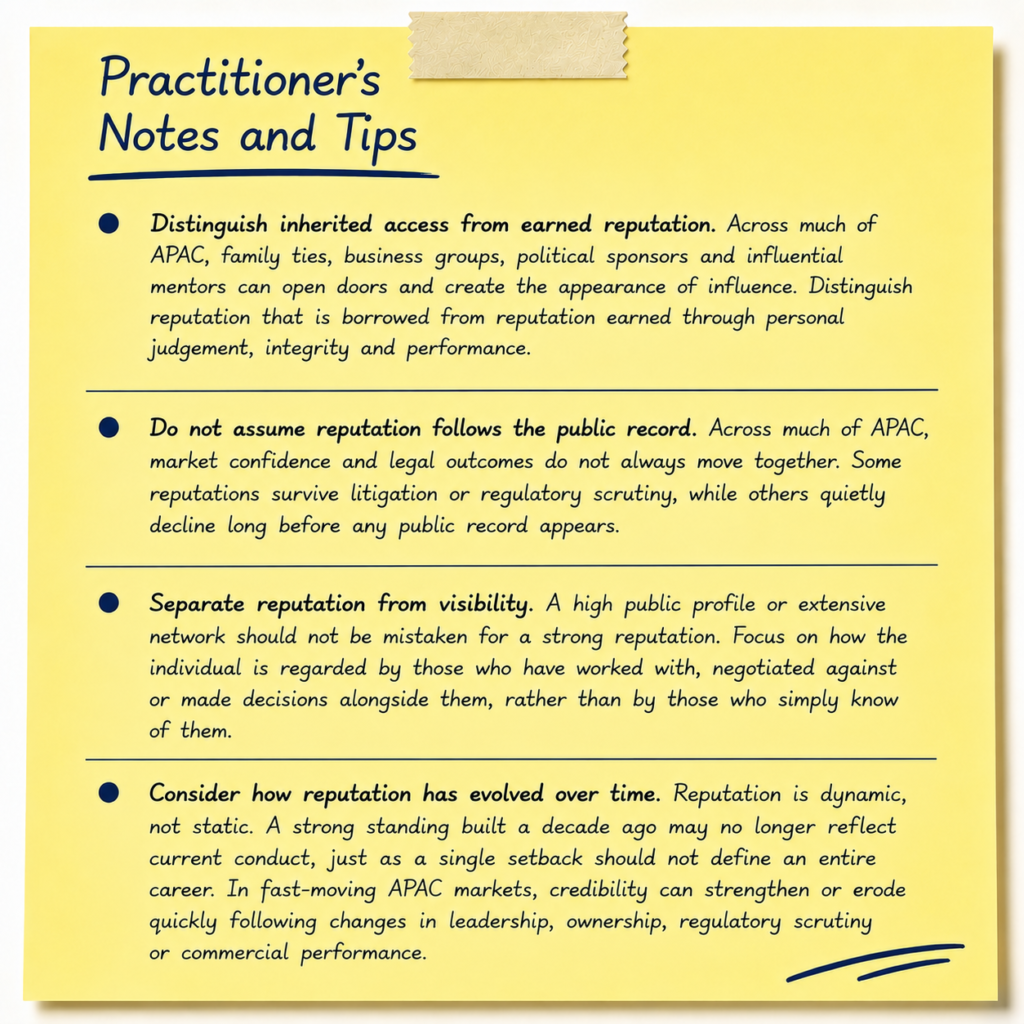
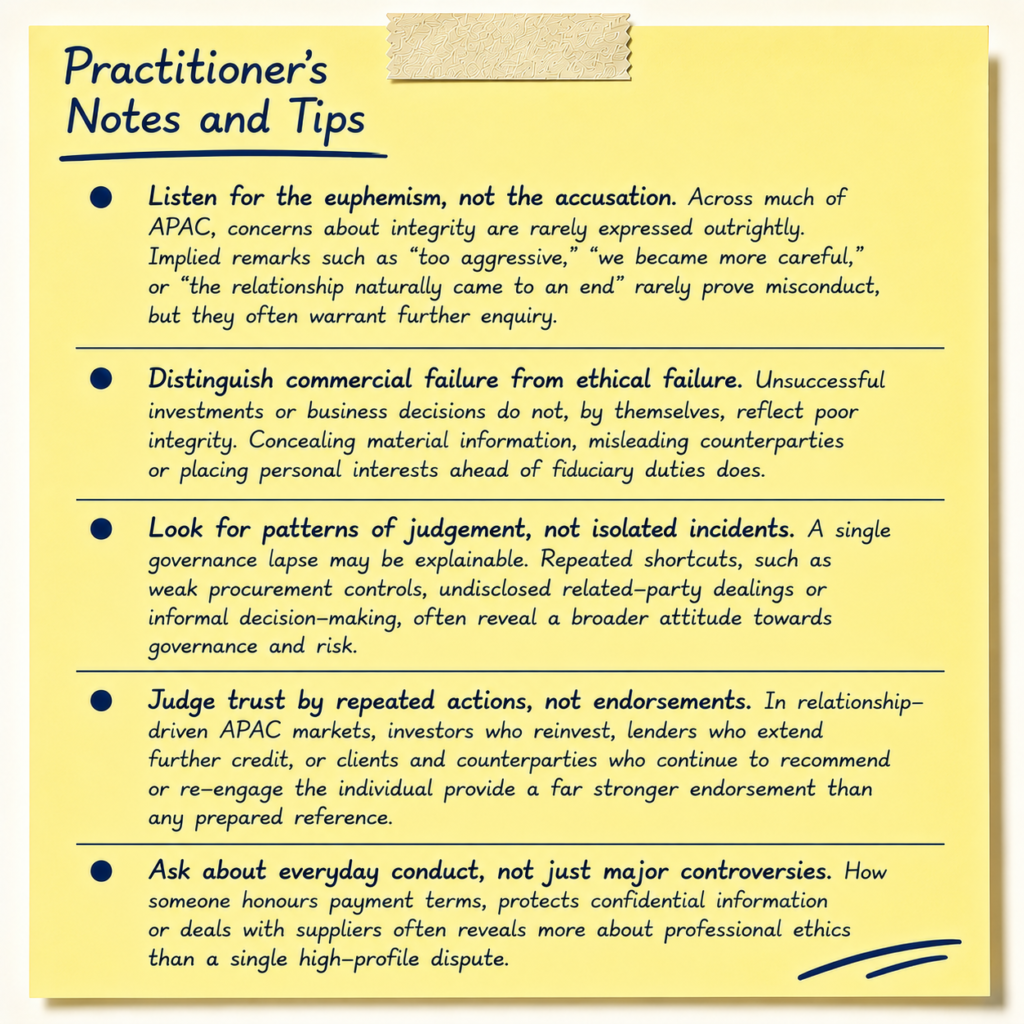
A. Professional Reputation: Read Past the Curated Reference
Reference checks remain popular because they are inexpensive and easy, not necessarily because they are reliable. Nominated referees are selected because they are expected to speak favourably, making them closer to character witnesses than independent accounts. Their views are useful, but they represent one perspective, not the conclusion. Equally important is watching out for repeated use of the same referees across multiple roles. That is not necessarily misleading, but it is one curated channel. What sits outside it tends to carry more weight.
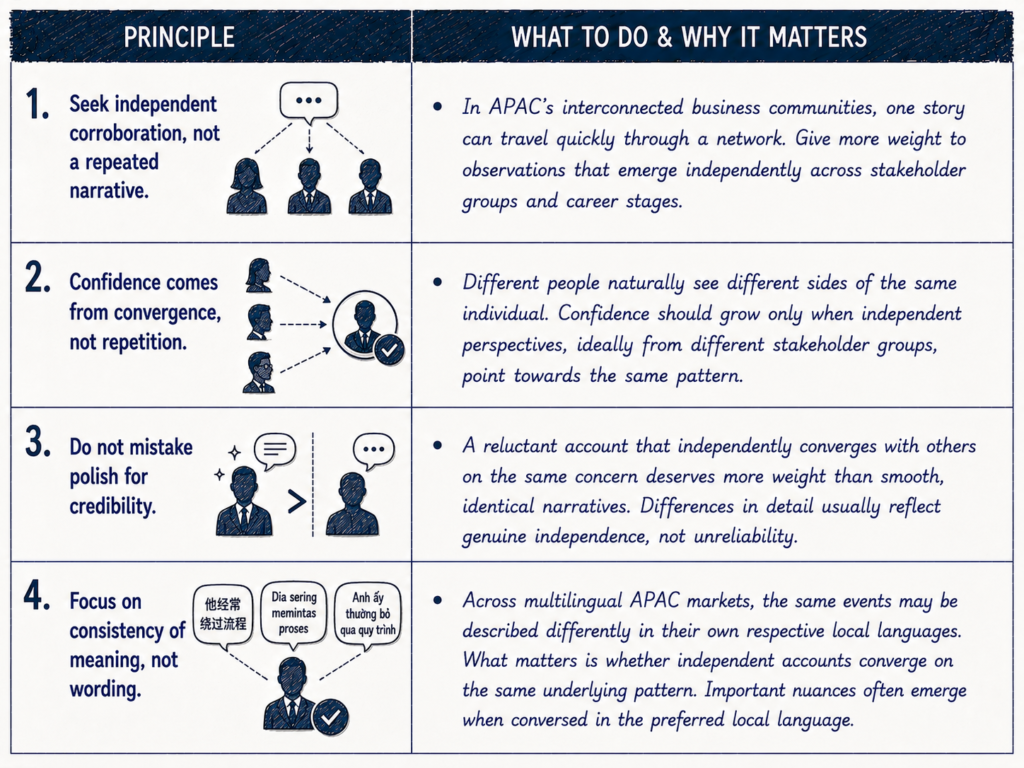
Meaningful insight comes through convergence, not eloquence. The goal is to see whether the same pattern emerges independently across an individual’s professional circle. A former colleague may remember one’s decision-making under pressure; a counterparty on commercial conduct; an adviser on governance and judgement. No single account is complete, but a pattern that surfaces independently is more reliable than any polished endorsement. Conversely, uniformly smooth, near-identical praise from unrelated referees can signal a coordinated narrative rather than genuine consensus.
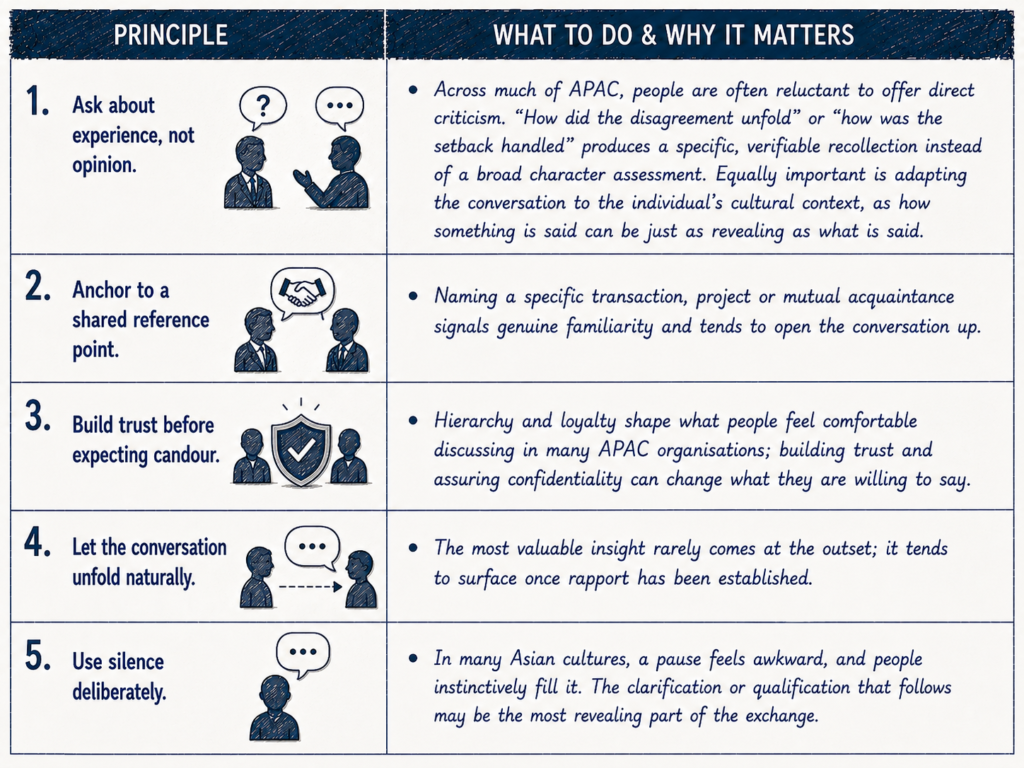
The most revealing conversations also tend to focus on behaviour, not simply character. Asking whether someone has a “good reputation” invites opinion; asking how a negotiation unfolded, how conflict was resolved, or how minority shareholders were treated invites specific recollections that are harder to manufacture, and a firmer basis for assessing recurring patterns.
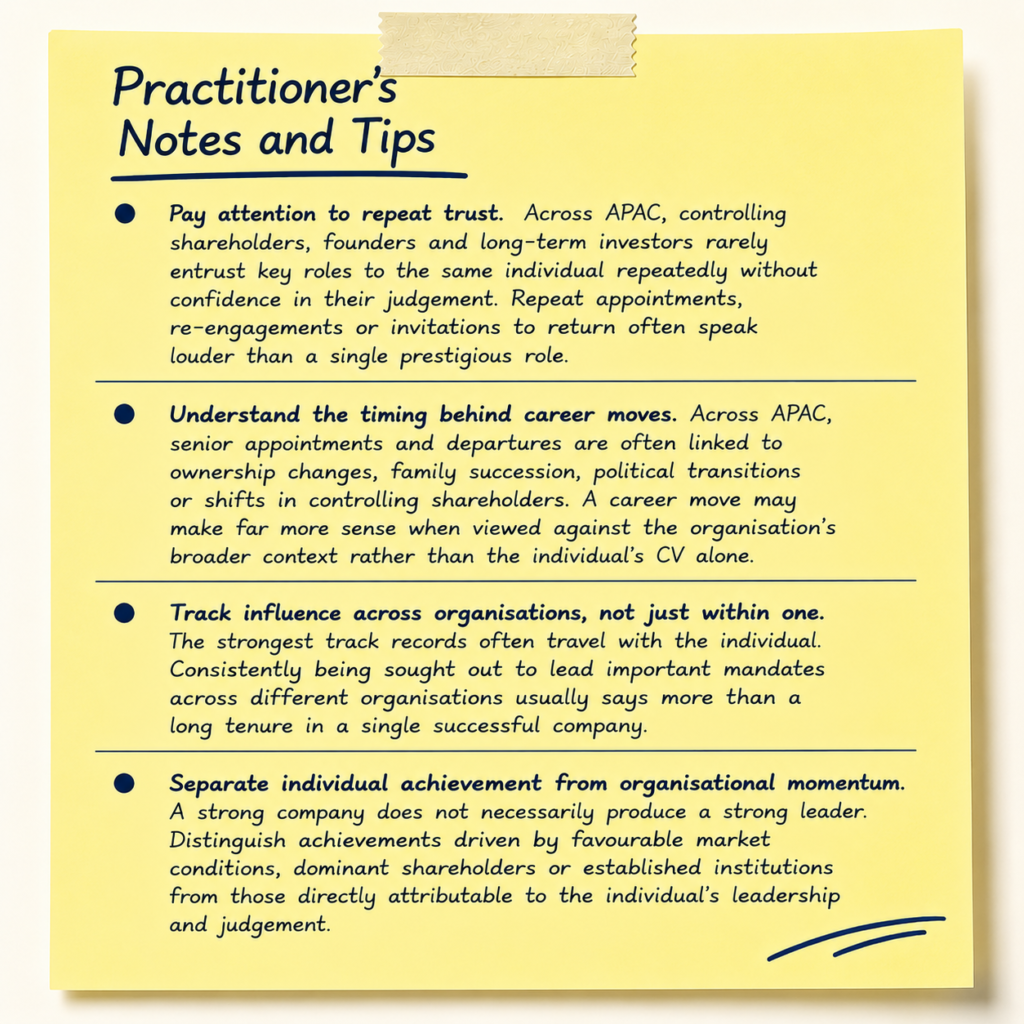
B. Track Record and Professional Performance: Look Beyond Titles and Timelines
A résumé, investment memorandum or pleading records what someone claims. Independent enquiries test whether those claims withstand independent scrutiny and, more importantly, reveal the substance behind them: actual responsibilities, influence, judgement and performance, rather than simply confirming dates or job titles.
Titles alone may not be accurate indicators. A CEO of a listed multinational and one of a privately held business may carry vastly different responsibilities. Across many family-controlled APAC enterprises, proximity to the controlling shareholder matters more than formal reporting lines. Someone junior on the org chart may shape key decisions, while a senior title may carry little real power. Look past the chart: who made the key decisions, and how was the individual’s contribution actually viewed by colleagues, counterparties and advisers?
Departures deserve the same scrutiny. An abrupt resignation or an otherwise illogical career move is not automatically a concern, but it should prompt a further question. Across much of APAC, “face-saving” means sensitive departures might be explained in neutral language, or not at all; treat the stated reason as one part of the picture. The same applies to rapid promotions or career gaps: they matter less if they hold up against independently verified recollections. Moments of genuine stress, such as a restructuring, a funding crunch, can also reveal more about an individual’s real capability than years of routine performance.
C. Integrity, Ethics and Professional Conduct: Read Behaviour, Not Labels
Integrity is seldom revealed by criminal records, regulatory actions or media reports alone. More often, it is reflected in patterns of behaviour: overpromising, shifting blame, sidestepping governance or placing personal interests ahead of broader responsibilities. These behaviours can materially affect employers, investors and counterparties without ever appearing in a searchable record. Across much of APAC, where preserving relationships and saving face often influence how disputes or discovery of wrongdoings are resolved, the absence of a formal record may say more about the process than the conduct itself.
Equally, allegations should never be mistaken for proof. A single account, particularly one shaped by personal interests or grievances, carries limited weight on its own. Greater confidence comes when similar observations emerge independently from people with relevant knowledge and no apparent reason to reach the same conclusion. Rather than simply asking whether someone was “ethical”, ask how they managed a conflict of interest, balanced competing stakeholder interests or responded when a decision went wrong. Behaviour under pressure is often the clearest window into integrity.
Finally, interpret integrity within its cultural and commercial context. Standards of acceptable business conduct are not always applied uniformly across APAC, and practices regarded as inappropriate in one jurisdiction may be viewed as customary or commercially necessary in another. The objective is not to impose a single standard, but to understand the circumstances, local expectations and the individual’s judgement within that environment.
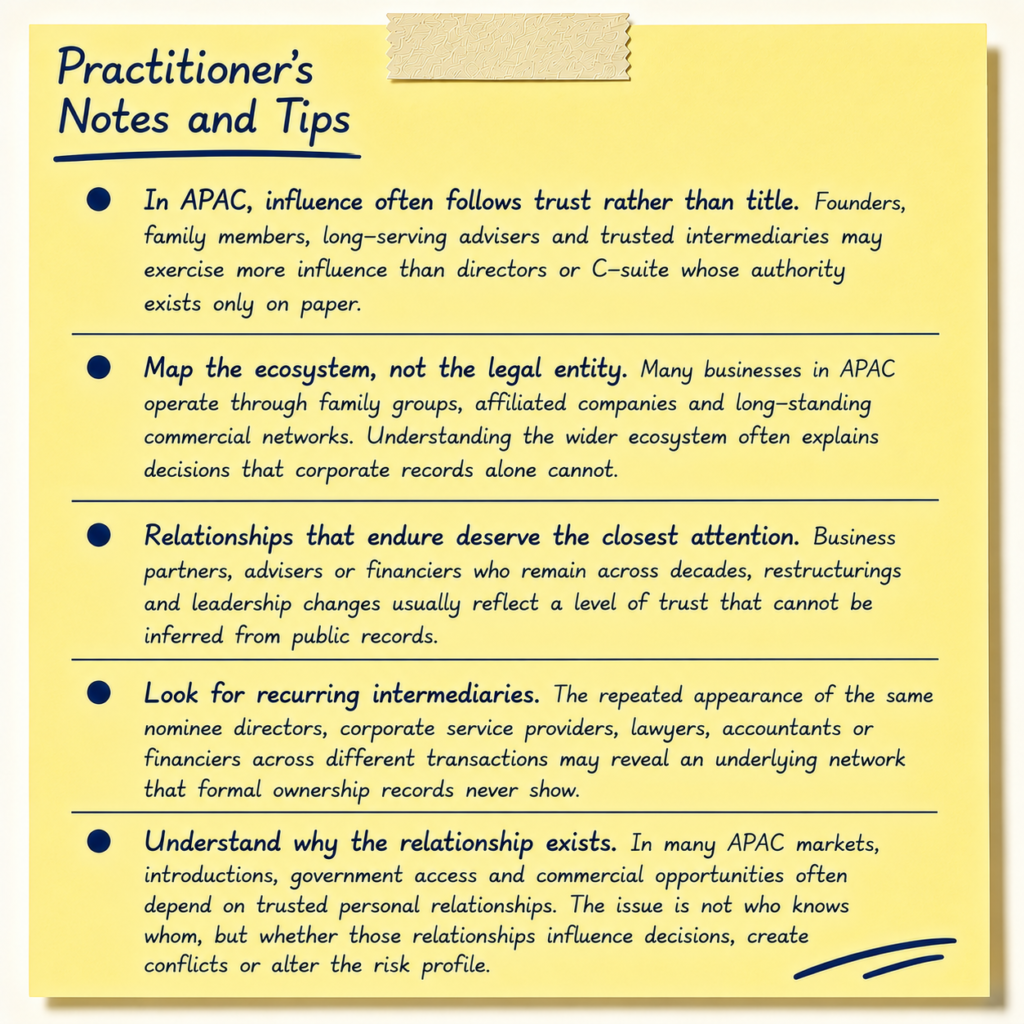
D. Relationships and Networks: The Companies and People Behind the Individual
Public records identify directorships and shareholdings; they seldom explain the nature and strength of the relationships behind them. This particularly matters across much of APAC, where business is deeply relationship-driven. Family ties, long-standing partners, political connections and trusted advisers often shape decisions as much as formal governance structures. Some of the most influential individuals hold no official position at all.
Look past the chart. Ask who the individual is connected to, how those relationships developed, and if they recur across companies, transactions or over time. A recurring adviser or network appearing across multiple ventures provides context invisible in public records. The aim is not guilt by association, but to understand whether they meaningfully alter the risk profile. Equally important is interpreting them proportionately and within the legal, commercial and cultural context of the relevant jurisdiction. A shared directorship alone rarely proves influence; a recurring and independently verified network often tells a far more informative story.
The trajectory of a relationship should also be considered. Associations with individuals or organisations whose influence, credibility or financial standing is strengthening may have different implications from those facing sustained regulatory, financial distress or reputational decline. It is not the association itself that matters, but what the broader pattern reveals when viewed in context and over time.
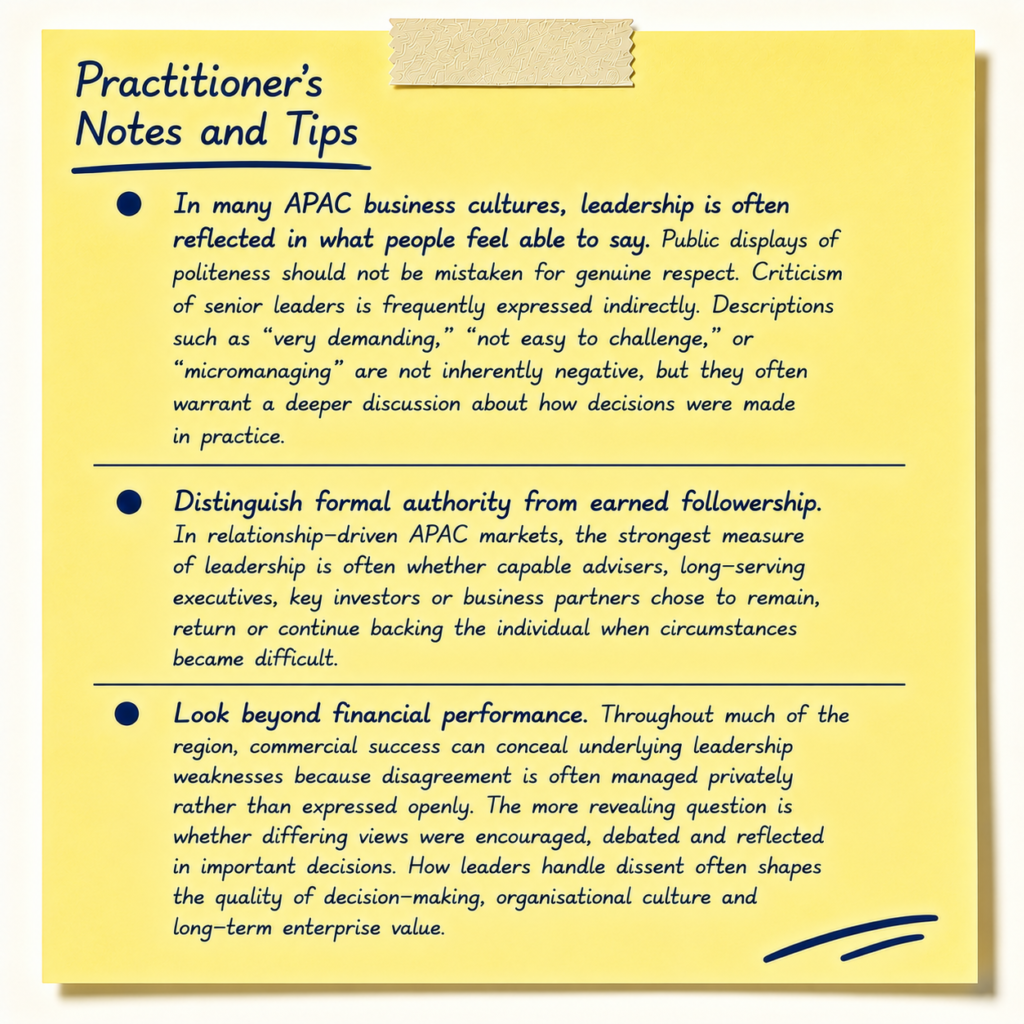
E. Leadership and Judgement: Performance Under Pressure
Technical competence is comparatively easy to verify. Leadership abilities and judgement under pressure is not. It rarely appears in a résumé, an investment memorandum or a corporate biography. Instead, it emerges through the recollections of people who experienced real uncertainty alongside the individual: a restructuring, a failed raise, a collapsed deal.
Equally revealing is how the same person is perceived by different audiences. Someone who manages upward well and polished with the Board can simultaneously preside over declining morale several levels down. Neither account is wrong; each sees a different part of the same picture, and a balanced assessment needs both. Therefore, probe behaviour, not attributes: ask not whether someone was a “good leader” but how a difficult decision was made or disagreement was handled. This prompts specific recollections that can be tested against independent accounts.
Leadership is measured not simply by results, but by the judgement behind them. Success can be assisted by favourable markets, strong institutions or capable teams. The true test comes when information is incomplete, outcomes uncertain and competing interests collide. Those are the moments that distinguish technical competence from genuine leadership.
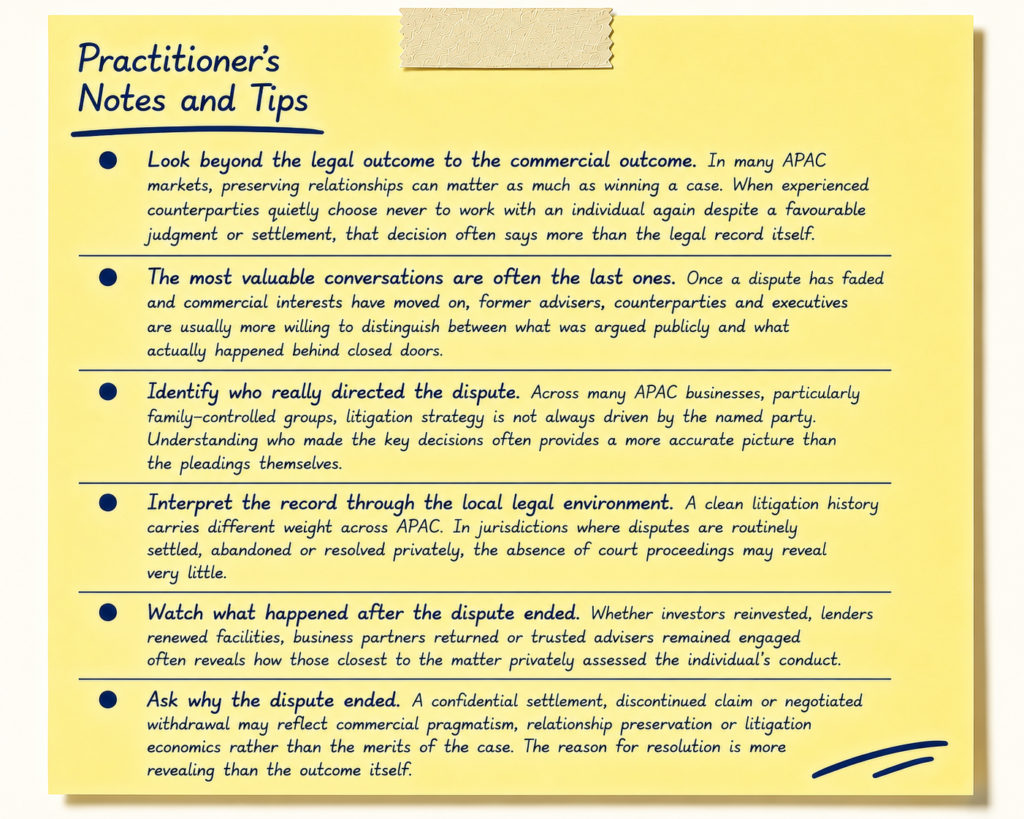
F. Litigation, Regulatory and Commercial Matters: Read the Outcome, Not Just the Record
Court and regulatory decisions establish what was decided; they hardly explain why events unfolded as they did or the extent of an individual’s actual role. Commercial disputes can arise from serious governance failures, genuine differences over commercial terms or strategic litigation. Treating every adverse record as misconduct oversimplifies what is usually more nuanced. This is where independent enquiries add real value: rather than treating a record as the conclusion, they draw on people involved or well-positioned to reveal what happened.
What triggered the dispute? How did the individual respond under pressure? Did they accept responsibility, seek a practical resolution or unnecessarily escalate the situation? These perspectives often reveal more about judgement, integrity and professional conduct than the legal or regulatory outcome alone, which may reflect commercial leverage, evidential constraints or settlement dynamics as much as culpability.
The same principle applies where the public record is silent. Across much of APAC, it is not uncommon for disputes to be resolved privately long before any judicial or regulatory finding is made. Silence should not automatically be interpreted as the absence of risk. Its significance depends on the jurisdiction. In markets such as Singapore and Hong Kong, where litigation is a realistic option, a clean record carries greater evidential value. In jurisdictions where disputes are more commonly settled confidentially or quietly buried, it carries less. Independent enquiries provide the context needed to understand not only what the public record shows, but also what it leaves unsaid.
Practical Considerations for Effective Independent Enquiries
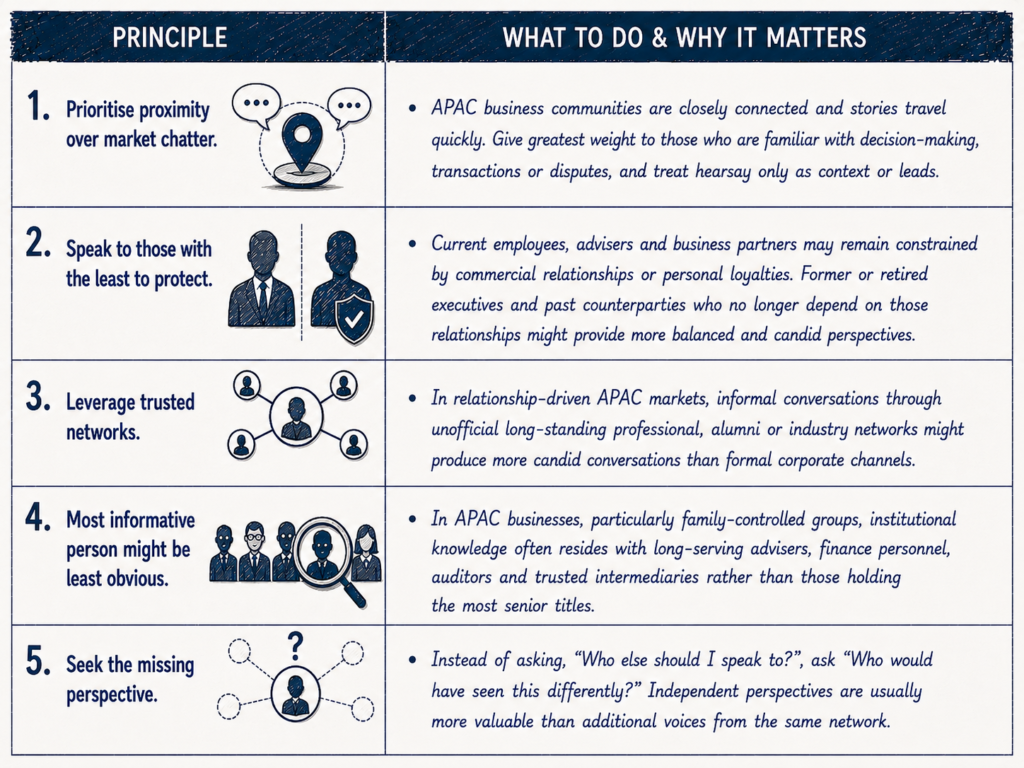
A. Select the Right People: An Enquiry Is Only as Good as the People You Speak To
An enquiry is only as good as who is asked, not just what is asked. Some people have only limited knowledge or exposure; others may have reason to protect or criticise the individual. The goal is identifying those genuinely best placed to give an informed, independent view.
B. Ask Better Questions: Natural Conversations Reveal More Than Prepared Questionnaires
Prepared questionnaires often produce predictable answers. Better conversations develop naturally, allowing experiences and context to emerge progressively.
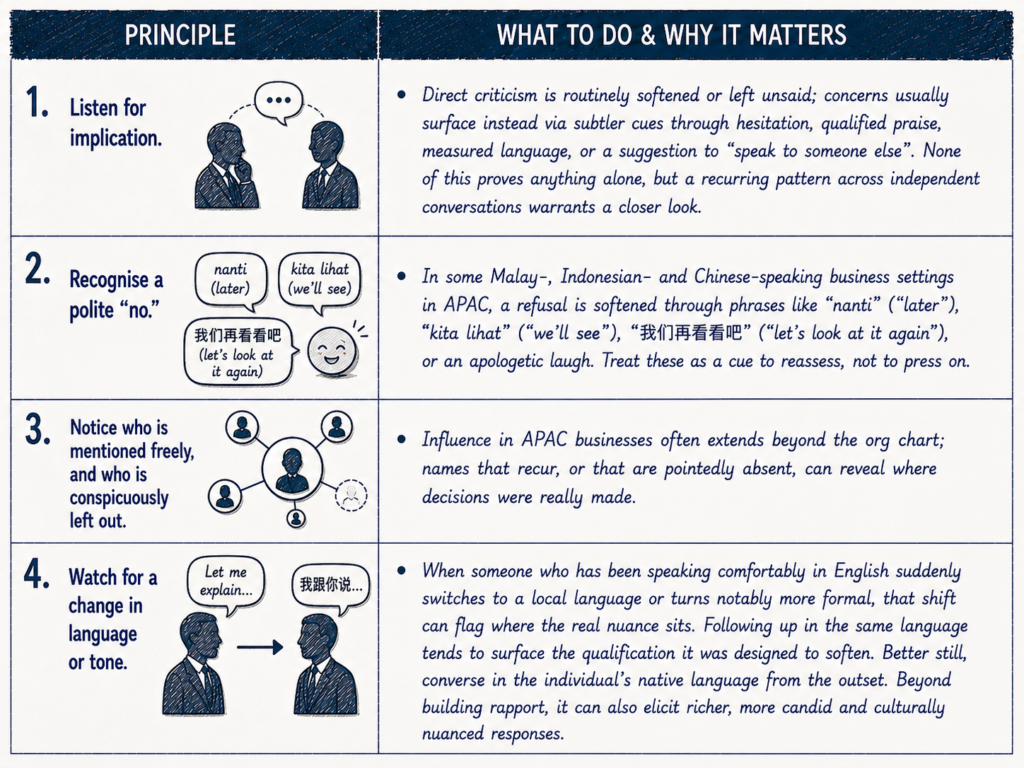
C. Read the Room: Cultural Cues and What Goes Unsaid
Communication is never just words. Across much of APAC, relationships, hierarchy and avoiding unnecessary loss of face often shape how issues are expressed. Cultural fluency is required to recognise that implication and understatement carry as much meaning as direct statement.
D. Corroborate and Evaluate: Look for Convergence, Not Consensus
Reliability is not built by hearing the same story repeatedly. It comes from independent observations that converge on the same pattern, despite different wording and vantage points.
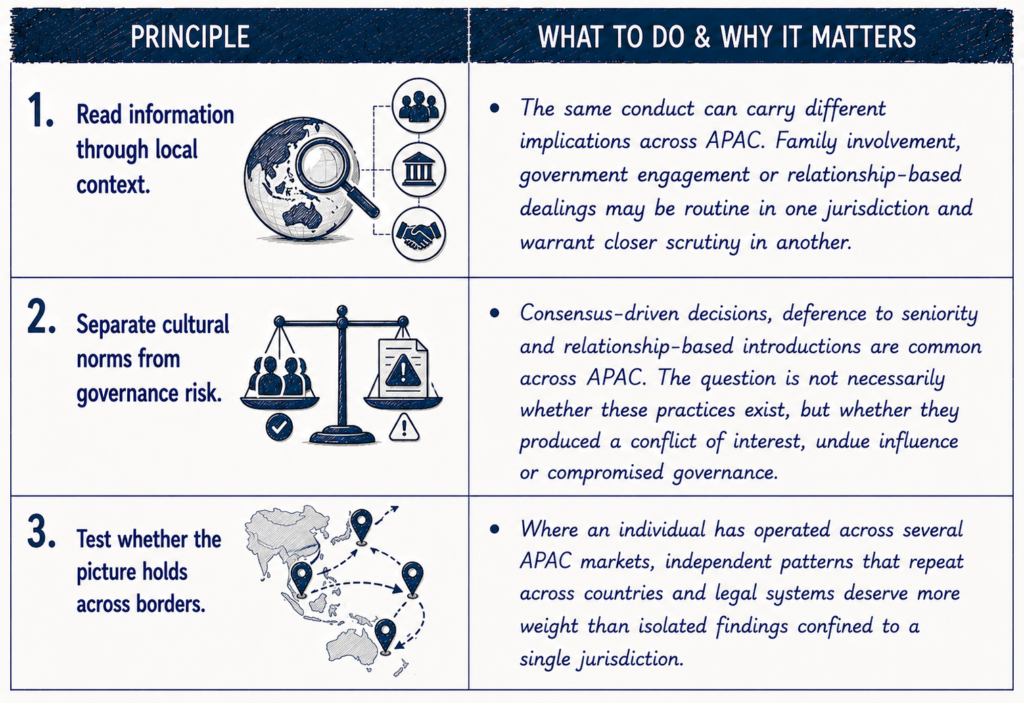
E. Build the Final Picture: Judgement Comes from the Whole, Not the Parts
No single chronology, appointment, adverse record or conversation is decisive on its own. A sound assessment depends on whether the available evidence, taken together, forms a coherent, defensible picture.
Concluding Reflections: Trust, But Verify
The people who cause the greatest damage succeed either because they are exceptionally deceptive or because assumptions go unchallenged, inconsistencies go unnoticed, and omissions are mistaken for reassurance.
Effective background screening is not measured by the sheer volume of information collected, but by the quality of the judgement applied to it. That means independently verifying what matters, recognising what remains uncertain, and interpreting every finding within its proper local context and nuances.
Public records report factual data; independent enquiries provide context; professional judgement connects the two into understanding. The strongest conclusions rest on independent evidence that consistently points the same way, never on a single document or conversation.
Trust should be the outcome of verification, never a substitute for it. Screening is not about eliminating uncertainty. It is about testing what can reasonably be tested, challenging assumptions, corroborating what matters, and recognising that what is absent can be as revealing as what is disclosed.
In the end, organisations are rarely undone by what they could never have known. They are undone by what was already there to be found — had someone asked one more question, verified one more claim, or recognised that the greatest risk was not what was visible, but what had quietly been left out. A background check is not simply about confirming a person's story. It is about looking beyond it. Because trust is strongest when it has been verified.
⚠️ Disclaimer: This guide is intended as general professional guidance, not legal or commercial advice. Readers should consult qualified counsel on the specific legal and regulatory requirements applicable to background screening in their own jurisdiction.